 ALPHA-VAL
The model does
- Read your documents and find the parameters in them
- Normalise units, naming and stream references across sources
- Flag contradictions and missing inputs for a human to resolve
- Draft the assumption and its stated basis for your review
How it works
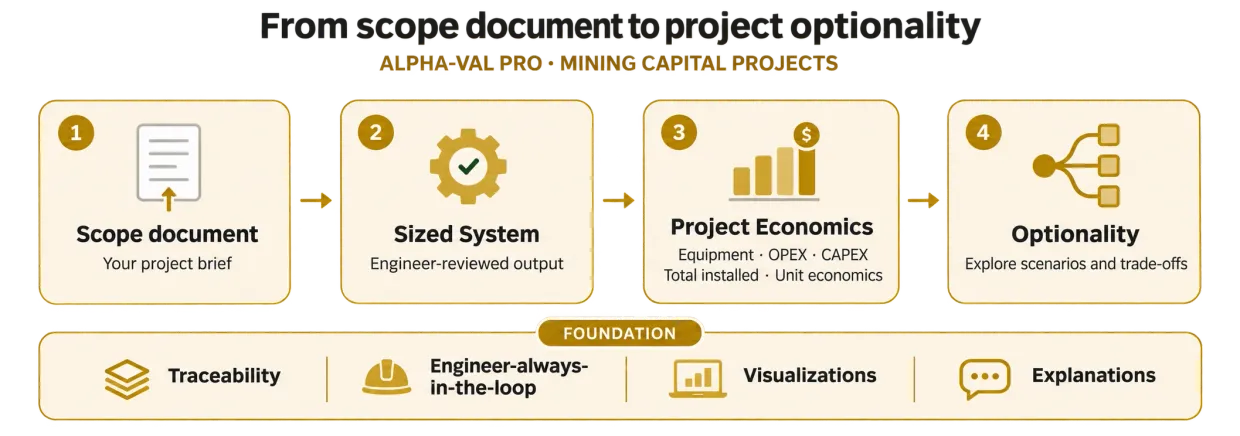
Four steps. Nothing hidden at any of them. You can stop at the end of each one, read what the system decided, and change it.
The problem
A study prices a small set of configurations because each one demands manual sizing, assumptions and costing. The rest are dropped before anyone sees what they would have cost.
Scroll to watch a typical study narrow its options.
Step 01
A scope of work, a design basis memo, a vendor datasheet, or a published feasibility study. The model reads it and records the page each input came from. It does not size or price anything.
Before anything is sized, the screening gate lists every gap: itemised, and routed to the person who holds the answer. Where your intent is missing, it stops and asks.
Step 02
A deterministic engine sizes the equipment and prices it, the same way every time. Each item is sized by a published method. Bond and Rowland for comminution, CEMA for conveying, Jenike and Beverloo for storage and discharge, Karra for screening.
Step 03
Every input, intermediate and output carries its symbol, unit, value and source. Follow any cost back through the size and the method to the page it started on.
Step 04
Installed cost as a band, net present cost per ton, and the ranking across every configuration you asked for. Eliminated options keep their reasoning.
The product
Real screens from the product, on synthetic project data. Switch views to look around.
The model does
The model never does